yán wéi

延維Yanwei

The double-headed serpent god of Mount Yue whose sighting enables kings and dukes to claim hegemony over all under Heaven.岳山幽深苍翠,苗民之地灵气蒸腾。

Form人首

Human head and serpent body生有人头配以蛇身

人首蛇身

Heads二首

Heads on both left and right身躯左右各有头颅

左右有首

Coat紫衣

Dressed in purple robes, cap身穿紫衣头戴旃冠

衣紫衣,冠旃冠

Might霸業

Rulers feast him to rule all人王享之伯天下

伯天下

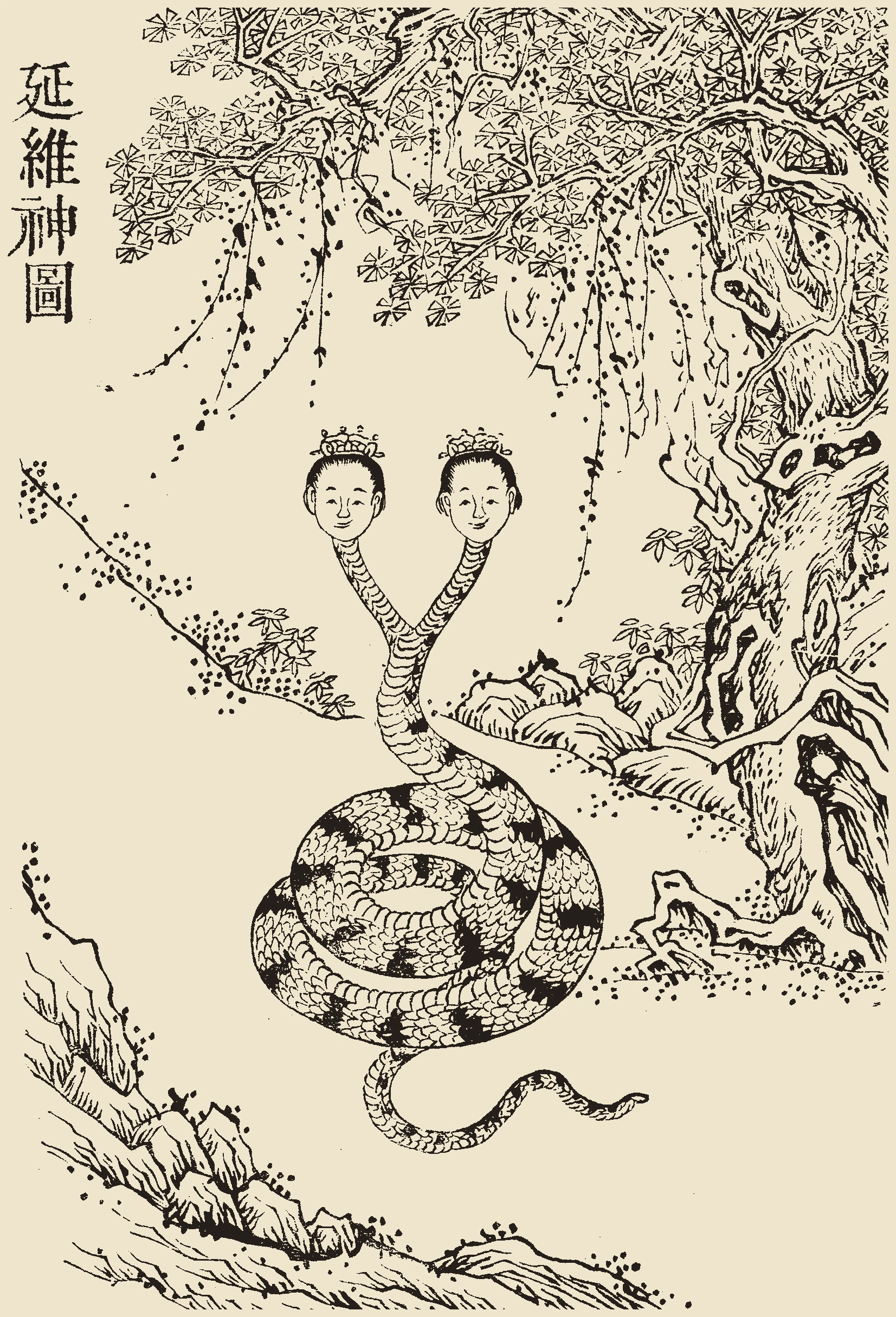
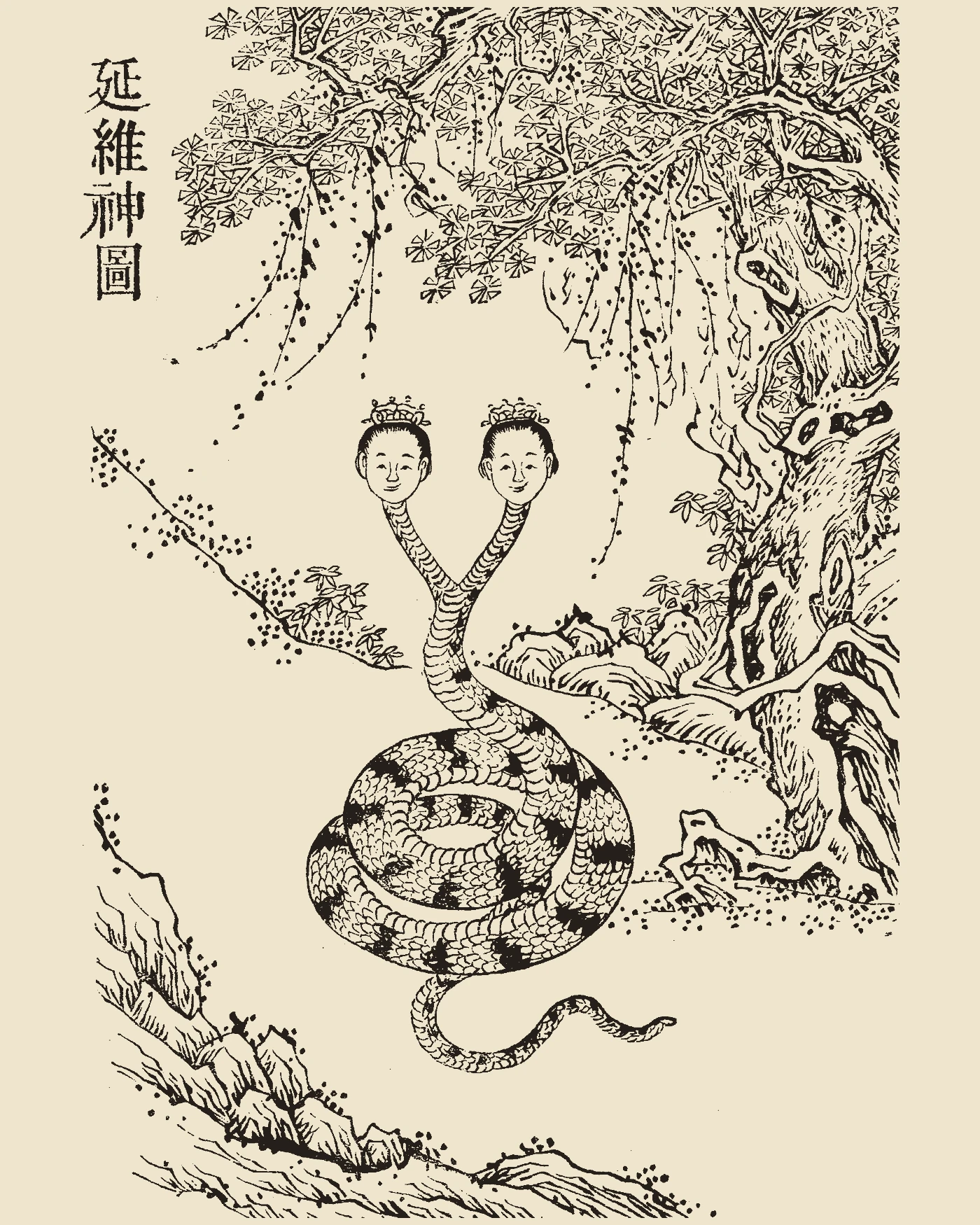
《清内府铜活字印本《古今图书集成·神异典》》版画:延維左首旃冠Left Head & Crown左側人面所戴之紅旃法冠左首旃冠Left Head & Crown左側人面所戴之紅旃法冠右首旃冠Right Head & Crown右側人面所戴之端整高冠右首旃冠Right Head & Crown右側人面所戴之端整高冠紫衣Purple Robe彰顯王霸之氣之尊貴紫袍紫衣Purple Robe彰顯王霸之氣之尊貴紫袍蛇軀Shaft-Long Serpent長如王車大轅之青鱗蛇身蛇軀Shaft-Long Serpent長如王車大轅之青鱗蛇身
兩首霸神

Double-Headed Hegemon Serpent

山海經·海內經
延維圖, 清内府铜活字印本《古今图书集成·神异典》, woodblock print, 1726古籍刻本《清内府铜活字印本《古今图书集成·神异典》》“延維图”,公有领域版画 · Public domain公有领域

Highlighted words: anatomy part · feature · form type — tap to jump标色词:形态部位 · 特征 · 形态类别,点击可跳转

The texts原文

Original Text & Translation原文与译文

山海經·海內經 · Shan Hai Jing · Classic of Regions Within the Seas · Wikisource

有神焉,人首蛇身,長如轅,左右有首,衣紫衣,冠旃冠,名曰延維,人主得而饗食之,伯天下。
There is a god here with a human head and snake body, as long as a wagon shaft, with heads on both left and right, dressed in purple robes and crowned with a felt cap, named Yanwei; if a lord of men obtains and feasts him, he shall become hegemon over all under Heaven.
Show all sources (3)展开全部出处(3)

莊子·達生 · Zhuangzi: Mastering Life《莊子·外篇·達生》 · Wikisource

委蛇,其大如轂,其長如轅,紫衣而朱冠。
The Yanwei serpent is as large as a chariot hub and as long as a wagon shaft, clad in purple garments with a vermilion crown.
Zhuangzi narrates the famous encounter of Duke Huan of Qi with the two-headed serpent which portended his imperial hegemony.

Comparing the Books典籍对比

Celebrated in both the Shan Hai Jing and Zhuangzi (where Duke Huan of Qi falls ill upon meeting him until Guan Zhong explains the omen of hegemony), Yanwei is China's premier serpent omen of political greatness.

While the Shan Hai Jing records Yanwei as a two-headed snake-bodied creature whose sighting induces illness unless comprehended, Zhuangzi re-interprets the serpent as a supreme imperial omen: whoever beholds the crowned purple serpent is destined for dynastic hegemony.
The story来历与故事

The double-headed serpent god of Mount Yue whose sighting enables kings and dukes to claim hegemony over all under Heaven.

The Lore of Yanwei延維之古籍神异记述

Among the forested vales of Mount Yue and the ancient borderlands of the Miao pe岳山幽深苍翠,苗民之地灵气蒸腾。在古林深泽之间,常有两头巨蛇蜿蜒游走于花丛草莽。

Among the forested vales of Mount Yue and the ancient borderlands of the Miao people dwelt the double-headed sovereign serpent Yanwei. Stretching as long as the heavy wooden draft-

shaft of a royal chariot, his winding scaled body bore a crowned human head at each end. Clad in sumptuous imperial purple silks and crowned with broad ritual felt caps, Yanwei moved with uncanny poise through the sacred marshlands. Ancient chronicles recorded that whenever a mortal prince or king possessed the destiny to unite the war-torn lands, he would encounter Yanwei. By making offering and feasting the two-headed god, the ruler was assured undisputed hegemony across all under Heaven.

委蛇,其大如轂,其長如轅,紫衣而朱冠。

The Yanwei serpent is as large as a chariot hub and as long as a wagon shaft, clad in purple garments with a vermilion crown.

— 莊子·達生 · Zhuangzi: Mastering Life《莊子·外篇·達生》

Mythological Legacy of Yanwei《山海經·海內經》典籍与文化传承

Yanwei (also known as Weituo 委蛇) plays a pivotal role in philosophical Daoism and pre-Qin political prophecy, immortalized in Zhuangzi as the auspicious apparition granting Duke Hu

有神焉,人首蛇身,長如轅,左右有首,衣紫衣,冠旃冠,名曰延維,人主得而饗食之,伯天下。

There is a god here with a human head and snake body, as long as a wagon shaft, with heads on both left and right, dressed in purple robes and crowned with a felt cap, named Yanwei; if a lord of men obtains and feasts him, he shall become hegemon over all under Heaven.

— 山海經·海內經 · Shan Hai Jing · Classic of Regions Within the Seas

an of Qi his rightful hegemony.

The phrase 'wandering with Yanwei' (委蛇/逶迤) entered classical rhetoric to describe graceful, winding adaptation and unperturbed ease, transforming a primeval two-headed serpent into a celebrated philosophical concept.

Record档案

Record Card档案卡

Type神
Also known asYanwei 延維; Weituo 委蛇; Sovereign Hegemon Serpent 伯天下之神
HabitatMount Yue in the Central/Hainei regions (岳山,苗民之境)
Robes & CrownDressed in purple robes, crowned with a large felt cap (衣紫衣,冠旃冠)
Imperial HegemonyAny sovereign ruler who feasts him gains supreme hegemony over the realm (人主得而饗食之,伯天下)
Earliest source山海經·海內經
Source books山海經·海內經
Image sourceChen Menglei 陳夢雷 (ed.) · Wikimedia Commons
LicensePublic domain

Frequently Asked Questions

Who is Yanwei in the Shan Hai Jing?

Yanwei is a double-headed, human-headed serpent god who wears purple robes and a felt hat, famed for granting imperial hegemony to mortal sovereigns.

What does 'Bo Tianxia' (伯天下) signify?

'Bo Tianxia' means becoming the supreme Hegemon (Ba 霸) of all China, uniting all feudal dukedoms under undisputed royal authority.

How is Yanwei connected to the philosopher Zhuangzi?

In Zhuangzi's chapter 'Mastering Life' (達生), Duke Huan of Qi meets Yanwei in a marsh and falls ill with fear until his advisor explains that seeing the Weituo is the destined omen of hegemony.

See also另见

  • Feiyi — Both Yanwei and Feiyi are extraordinary serpentine wonders possessing multi-headed or multi-bodied forms.延维与肥遗同为《山海经》中兼具两头或双身的异种神蛇典型。
  • Liangtoushe — Both represent two-headed reptilian omens whose encounter challenged ancient observers to decipher divine portents.延维与两头蛇同为华夏志怪中象征命运际遇与天机昭示的双首灵异之蛇。